
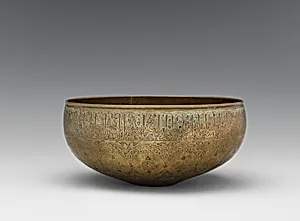
Bowl
Unknown Artist
13th century
Medium
Bronze; engraved and inlaid with silver
Dimensions
H. 3 5/16 in. (8.4 cm) Max Diam. 7 1/8 in. (18.1 cm)
Classification
Metal
Department
Islamic Art
Museum
Metropolitan Museum of Art, New York, NY
Credit
Edward C. Moore Collection, Bequest of Edward C. Moore, 1891
Accession Number
91.1.556
Rights
Public Domain
Art Historical Context
This elegant 13th-century bronze bowl, standing just over 3 inches tall and 7 inches wide, exemplifies the masterful metalworking traditions of the Islamic world. Crafted by an unknown artist, its surface is finely engraved and inlaid with silver, a known as damascening or koftgari. This labor-intensive process involved incising intricate patterns into the bronze and hammering silver wire into the grooves creating shimmering contrasts that catch the light and highlight motifs like arabesques, calligraphy, or geometric designs—hallmarks of Islamic decorative arts. Produced during a golden age of Islamic craftsmanship, likely in regions like Iran, Syria, or Egypt under Mongol or Mamluk influence, such bowls served both practical and ceremonial purposes. They held food, water, or rosewater for handwashing at lavish feasts, symbolizing the owner's wealth and piety through their refined beauty and avoidance of human figural representation in line with Islamic aniconism. Now part of the Metropolitan Museum of Art's Islamic Art collection, gifted through the Edward C. Moore bequest in 1891, this bowl invites us to appreciate the ingenuity of medieval artisans. Its enduring luster speaks to techniques that bridged utility and artistry, offering a tangible glimpse into a vibrant cultural heritage.