
Bowl
Unknown Artist
13th century
Medium
Stonepaste; overglaze luster-painted on an opaque white glaze
Dimensions
H. 3 3/4 in. (9.5 cm) Diam. 8 1/16 in. (20.5 cm)
Classification
Ceramics
Department
Islamic Art
Museum
Metropolitan Museum of Art, New York, NY
Credit
Purchase, Edward C. Moore Jr. Gift, 1927
Accession Number
27.13.9
Rights
Public Domain
Tags
Art Historical Context
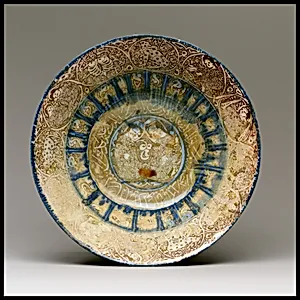
This shallow bowl draws the eye first to its central medallion, where small human figures and delicate script appear within a circular frame. Radiating bands of cobalt blue divide the interior, while the wide rim carries a continuous frieze of seated figures, scrolling vines, and calligraphy, all rendered in warm metallic luster against a creamy ground. The surface shows the subtle sheen and slight irregularities typical of overglaze painting on an opaque white glaze. Created in the thirteenth century by an unknown artist, the bowl is made of stonepaste and belongs to the collection of Islamic Art at The Metropolitan Museum of Art. Such works highlight the refined luster technique developed in the Islamic world, where metallic pigments were applied after the initial firing to produce shimmering effects. The vessel’s balanced composition and intricate surface decoration reflect the period’s high regard for both functional ceramics and celestial or narrative imagery.