
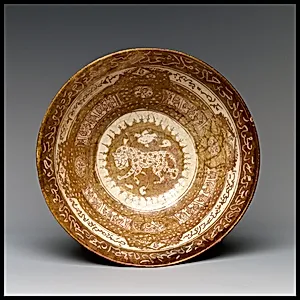
Bowl with Leopard
Unknown Artist
early 13th century
Medium
Stonepaste; luster-painted on opaque white glaze
Dimensions
H. 4 1/8 in. (10.5 cm) Diam. of rim: 8 3/4 in. (22.2 cm) Wt. 14.9 oz. (422.5 g)
Classification
Ceramics
Department
Islamic Art
Museum
Metropolitan Museum of Art, New York, NY
Credit
Gift of Dr. and Mrs. Lewis Balamuth, 1968
Accession Number
68.215.10
Rights
Public Domain
Tags
Art Historical Context
This ceramic bowl presents a striking central image of a spotted leopard striding across a circular medallion. Rendered in luster on an opaque white glaze, the appears in profile against a pale ground, surrounded radiating bands of intricate geometric and floral motifs. Outer rings flowing Arabic script, all executed in warm tones of gold and brown that catch the light, while the bowl’s gently curved form and slightly iridescent surface emphasize its luster-painted technique. Created in the early thirteenth century, the work is catalogued as stonepaste with luster-painted decoration on an opaque white glaze. Such vessels reflect the refined ceramic traditions of the Islamic world, where skilled potters combined technical precision with poetic imagery. The leopard, a symbol of strength and grace, sits at the heart of the design, inviting viewers to appreciate both the animal’s lively presence and the elegant calligraphy that frames it. Now part of the Metropolitan Museum’s collection of Islamic art, this bowl was generously given by Dr. and Mrs. Lewis Balamuth in 1968. Its intimate scale and luminous surface continue to offer visitors a direct connection to the artistic achievements of the period.