
Bowl
Unknown Artist
9th century
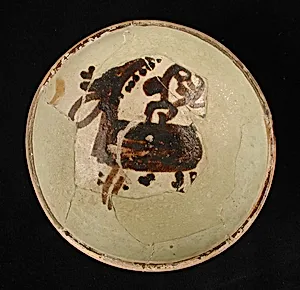
Medium
Earthenware; white slip with black slip decoration under transparent glaze
Dimensions
H. 1 13/16 in (4.6 cm) Diam. 4 3/4 in. (12.1 cm)
Classification
Ceramics
Department
Islamic Art
Museum
Metropolitan Museum of Art, New York, NY
Credit
Rogers Fund, 1938
Accession Number
38.40.164
Rights
Public Domain
Art Historical Context
This delicate 9th-century earthen bowl, standing just 1 13/16 inches tall and 4 3/4 inches in diameter exemplifies the refined ceramic artistry of the early Islamic world. Crafted with a white slip base adorned by black slip decoration and sealed under a transparent glaze, it reveals the sophisticated techniques developed during the Abbasid Caliphate. The slip—essentially liquefied clay—was applied in intricate patterns before glazing and firing, creating a glossy, durable surface that protected the vivid contrasts while allowing the bowl to serve both practical and aesthetic purposes in daily life. In the Islamic art tradition, such bowls were not mere utensils but symbols of cultural flourishing, produced in bustling centers like Iraq. The use of white slip over earthenware body mimicked costly Chinese porcelain, then unavailable in the West, showcasing artisans' ingenuity in color and form. This transparent glaze innovation enhanced durability and sheen, influencing ceramics across the Mediterranean and beyond. Today, housed in the Metropolitan Museum of Art's Islamic Art Department (acquired via the Rogers Fund in 1938), this modest vessel invites us to appreciate the anonymous mastery behind everyday beauty from a golden age of innovation.