
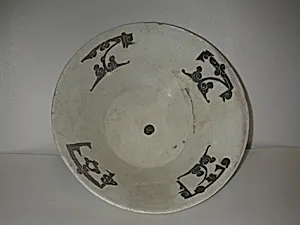
Bowl
Unknown Artist
10th century
Medium
Earthenware; white slip with incised black slip decoration under transparent glaze
Dimensions
H. 3 5/8 in. (9.2 cm) Diam. 10 7/16 in. (26.5 cm)
Classification
Ceramics
Department
Islamic Art
Museum
Metropolitan Museum of Art, New York, NY
Credit
Fletcher Fund, 1975
Accession Number
1975.195
Rights
Public Domain
Art Historical Context
This elegant 10th-century earthenware from the Islamic world exemplifies the refined ceramic artistry of the Abbasid era. Crafted as a shallow serving vessel—standing just3⅝ inches high and 10½ inches in diameter—it reflects the everyday beauty prized in medieval Islamic households, where functional objects doubled as canvases for artistic expression. Housed in the Metropolitan Museum of Art's Department of Islamic Art, it was acquired through the Fletcher Fund in 197. The bowl's striking decoration employs a sophisticated sgraffito technique: white slip base is coated with black slip, then incised to reveal contrasting patterns beneath a transparent glaze. This method, popular in 9th–11th-century Persia and Central Asia, created durable, lustrous surfaces resistant to wear while allowing intricate designs to emerge through scratching. The transparent glaze not only protected the earthenware but enhanced its visual depth, showcasing potters' mastery of layered color and texture without relying on costly pigments. Such bowls highlight the cultural flourishing of Islamic ceramics, bridging utility and aesthetics in a golden age of innovation. Visitors can appreciate how these anonymous artisans elevated daily life into art, influencing global pottery traditions for centuries.