
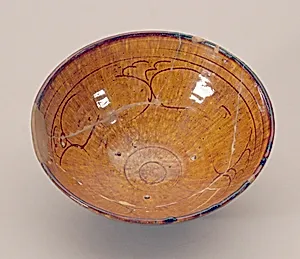
Bowl with Incised Decoration
12th/13th century
Medium
Earthenware with incised decorations on white slip under a light brown glaze
Dimensions
8.9 × 21.3 cm (3 9/16 × 8 7/16 in.)
Classification
ceramics
Department
Arts of Asia
Museum
Art Institute of Chicago
Accession Number
10823
Rights
Public Domain
Art Historical Context
This exquisite *Bowl with Incised Decoration*, crafted the Islamic world during the 12th 13th century, the refined ceramic artistry of the medieval Islamic era. Made from earthenware, the bowl features intricate designs incised through a white slip—a liquid clay layer—revealing the underlying body before being coated in a light brown glaze. This sgraffito technique, "scratched" in Italian, created subtle contrasts and depth, allowing artisans to produce elegant patterns without the need for costly pigments. Measuring just 8.9 × 21.3 cm, it was likely used for serving food or drink in a domestic setting, blending utility with beauty. Produced during a golden age of Islamic pottery, particularly in regions like Persia (modern Iran) or Central Asia, such bowls highlight the cultural exchange along Silk Road trade routes. Islamic ceramists innovated glazing and decoration methods, influencing later European and Asian traditions. The light brown glaze, achieved through specific firing techniques, provided a warm, durable finish that protected the delicate incised motifs—often geometric, floral, or calligraphic, reflecting aniconic principles in Islamic art. Housed in the Art Institute of Chicago's Arts of Asia department, this piece invites visitors to appreciate how everyday objects became canvases for sophisticated craftsmanship, showcasing the enduring legacy of Islamic innovation in ceramics.
About the Artist
Islamic
Islamic art, a profound visual tradition originating in the 7th century CE, flourished across vast territories from Spain to India under Muslim rule, encompassing architecture, ceramics, manuscripts, textiles, and metalwork produced by diverse artisans rather than a single named master. Drawing from pre-Islamic Sasanian, Byzantine, and late antique influences, its early development under the Umayy...