
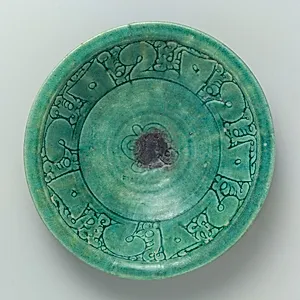
Bowl
Unknown Artist
11th–12th century
Medium
Stonepaste; incised and glazed
Dimensions
H. 3 in. (7.6 cm) Diam. 12 3/8 in. (31.4 cm) Wt. 29.9 oz. (847.7 g)
Classification
Ceramics
Department
Islamic Art
Museum
Metropolitan Museum of Art, New York, NY
Credit
Gift of Charles K. and Irma B. Wilkinson, 1977
Accession Number
1977.392.1
Rights
Public Domain
Art Historical Context
This elegant stonepaste bowl from the 11th–12th century the pinnacle of Islamic ceramic artistry during the medieval Islamic world, likely produced in regions like Persia or Syria under Seljuk patronage. Crafted from stonepaste—a composite of quartz, clay, and frit fired to mimic the translucency of Chinese porcelain medium was a groundbreaking innovation. It allowed artisans to create durable, high-quality vessels that surpassed earlier earthenware, reflecting the era's vibrant trade networks and technological exchange along the Silk Road. The bowl's surface features incised decoration, a technique where designs were meticulously carved into the unfired body before applying a glossy glaze. This sgraffito method revealed contrasting layers beneath, producing intricate patterns that might include geometric motifs, floral arabesques, or calligraphy—hallmarks of Islamic art's aversion to figurative representation in favor of rhythmic abstraction. At just 3 inches high and over 12 inches in diameter, it balanced practicality for serving food or drink with aesthetic refinement, underscoring how everyday objects became canvases for cultural expression. Today, this generous gift to the Metropolitan Museum of Art from Charles K. and Irma B. Wilkinson in 1977 invites us to appreciate the anonymous master's skill. Weighing nearly 30 ounces, its robust form speaks to both functionality and enduring beauty, a testament to the Islamic golden age's fusion of utility and splendor.