
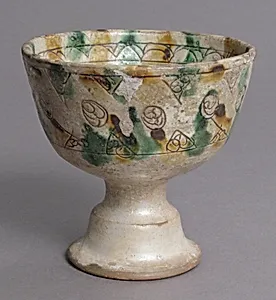
Bowl
Unknown Artist
12th–14th century
Medium
Earthenware, glaze
Dimensions
Overall: 3 13/16 x 4 in. (9.7 x 10.1 cm)
Classification
Ceramics
Culture
Byzantine
Department
Medieval Art
Museum
Metropolitan Museum of Art, New York, NY
Credit
Gift of Dikran G. Kelekian, 1912
Accession Number
12.45.4
Rights
Public Domain
Art Historical Context
This modest yet elegant earthenware bowl hails from the Byzantine Empire, dating to the 12th–14th—a vibrant era when Constantinople was a crossroads of Eastern and Western cultures. Crafted for everyday use, such vessels were staples in households, markets, and monasteries, reflecting the empire's sophisticated ceramic traditions amid political turbulence and artistic flourishing. The bowl's medium of glazed earthenware highlights key Byzantine innovations. Earthenware, fired at lower temperatures, was abundant and practical, while the glossy glaze not only sealed the porous clay for hygiene but also added a luminous sheen, often in turquoise or green tones inspired by Islamic influences from the Islamic world via trade routes. At just under 4 inches in diameter, its compact form suggests it held spices, dips, or small portions, underscoring the blend of utility and subtle beauty in medieval life. Now part of the Metropolitan Museum of Art's Medieval Art collection—thanks to a 1912 gift from Dikran G. Kelekian—this unassuming piece offers a tangible link to Byzantium's enduring legacy, where even humble objects embodied resilience and refinement.