
Bowl
Unknown Artist
late 4th–early 5th century
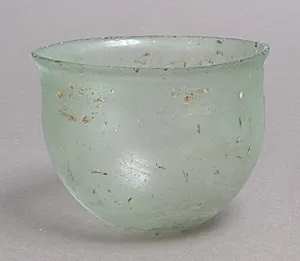
Medium
Glass
Dimensions
Overall: 2 1/2 x 3 1/4 in. (6.3 x 8.3 cm)
Classification
Glass-Vessels
Culture
Frankish
Department
Medieval Art
Museum
Metropolitan Museum of Art, New York, NY
Credit
Gift of J. Pierpont Morgan, 1917
Accession Number
17.191.359
Rights
Public Domain
Art Historical Context
This delicate glass bowl, crafted by an unknown Frankish artisan in the late 4th to early 5th century offers a glimpse into the daily life of early medieval Europe. Measuring just 2½ x 3¼ inches (6.3 x 8.3 cm), its petite size suggests it was likely used for drinking or holding small offerings, embodying the practical elegance of Frankish household wares. Acquired as a gift from financier J. Pierpont Morgan 1917, it now resides in the Metropolitan Museum of Art's Medieval Art Department. Dating to the turbulent Migration Period, when Germanic tribes like the Franks rose amid the Roman Empire's decline, this vessel reflects a fusion of Roman glassmaking traditions with emerging barbarian cultures. Frankish artisans in regions of modern-day France and Germany excelled in producing transparent, thin-walled glass through free-blowing techniques inherited from Rome— a labor-intensive process involving reheating molten glass on a blowpipe to shape it precisely. Its cultural significance lies in its rarity: such vessels highlight widespread glass trade and local production, symbols of status and continuity in a changing world. Though unadorned, its clarity and form speak to the sophisticated craftsmanship that bridged antiquity and the Middle Ages, inviting us to ponder the hands that once held it.