
Footed Bowl
Unknown Artist
late 4th–early 5th century
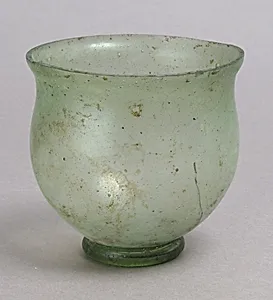
Medium
Glass
Dimensions
Overall: 2 15/16 x 2 15/16 in. (7.5 x 7.5 cm)
Classification
Glass-Vessels
Culture
Frankish
Department
Medieval Art
Museum
Metropolitan Museum of Art, New York, NY
Credit
Gift of J. Pierpont Morgan, 1917
Accession Number
17.191.353
Rights
Public Domain
Art Historical Context
This delicate footed bowl, crafted by an unknown Frankish artisan in the late 4th to early 5th century, exemplifies the refined glassmaking traditions of early medieval Europe. Measuring just under 3 inches in diameter, its petite form—complete with a sturdy foot for stability—suggests it was designed for intimate use, perhaps as a drinking vessel or cosmetic container in a household setting. Housed in the Metropolitan Museum of Art's Medieval Art department, it entered the collection as a gift from J. Pierpont Morgan in 1917, highlighting the era's transition from Roman imperial workshops to the vibrant craftsmanship of Germanic tribes like the Franks. Glass vessels like this one were prized for their translucency and versatility, produced using techniques such as blowing and molding that had evolved from Roman innovations. The Frankish culture, emerging along the Rhine frontier amid the waning Roman Empire, adapted these methods to create everyday objects that blended utility with subtle elegance. This bowl reflects the Migration Period's cultural fusion, where Frankish potters drew on late antique styles while forging a distinct identity that would influence Merovingian art. Its survival offers a rare glimpse into daily life during a transformative time, underscoring glass's role as an accessible luxury good traded across post-Roman Europe. Visitors can appreciate how such modest artifacts illuminate the ingenuity of anonymous makers.