
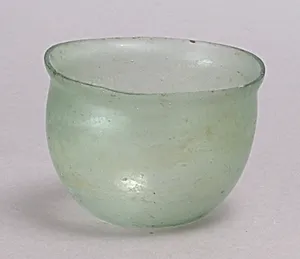
Bowl
Unknown Artist
late 4th–early 5th century
Medium
Glass
Dimensions
Overall: 2 5/8 x 3 5/16 in. (6.6 x 8.4 cm)
Classification
Glass-Vessels
Culture
Late Roman
Department
Medieval Art
Museum
Metropolitan Museum of Art, New York, NY
Credit
Gift of J. Pierpont Morgan, 1917
Accession Number
17.193.402
Rights
Public Domain
Art Historical Context
This delicate glass bowl, crafted by an unknown Late Roman artisan in the late 4th to early 5th century offers a glimpse into the everyday elegance of the waning Roman Empire. Measuring just 2⅝ × 3⅖ inches (6.6 × 8.4 cm), its petite size suggests it was likely used for serving small portions of food or drink at intimate meals, reflecting the refined domestic life of the period. Acquired as a gift from J. Pierpont Morgan in 7, it now resides in the Metropolitan Museum Art's Medieval Art department, bridging the classical world and early medieval traditions. Glass vessels like this one highlight the Romans' mastery of glassblowing, a technique perfected centuries earlier that allowed for lightweight, transparent forms produced in large quantities. By Late Antiquity, such bowls were ubiquitous across the empire, from villas in Italy to provincial outposts, symbolizing both functionality and subtle luxury. The clear or lightly colored glass—typical of the era—demonstrated advanced furnace control and molding skills, making fine tableware accessible beyond elite circles. As a survivor of nearly 1,600 years, this bowl underscores the cultural continuity of Roman craftsmanship amid empire's decline, influencing Byzantine and early Islamic glassmaking. Visitors can appreciate how such humble objects illuminate the textures of ancient daily life.