
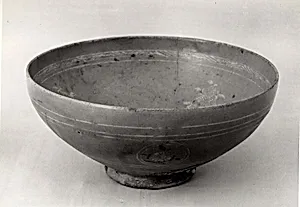
Bowl
Unknown Artist
late 13th century
Medium
Stoneware with inlaid decoration under celadon glaze
Dimensions
H. 3 1/2 in. (8.9 cm); Diam. 8 1/4 in. (21 cm)
Classification
Ceramics
Culture & Period
Korea · Goryeo dynasty (918–1392)
Department
Asian Art
Museum
Metropolitan Museum of Art, New York, NY
Credit
Gift of Samuel T. Peters, 1915
Accession Number
15.29.21
Rights
Public Domain
Art Historical Context
This elegant stoneware bowl from Korea's Goryeo dynasty918–1392), dating to the late 13 century, exemplifies the pinnacle celadon ceramic artistry. Crafted during a period when Buddhism flourished and royal patronage elevated pottery to an art form, such bowls were prized for both everyday use and ceremonial purposes in elite households. Its modest dimensions—3½ inches high and 8¼ inches in—belie its refined beauty, now housed in the Metropolitan Museum Art's Asian Art Department as a gift from Samuel T. Peters in 1915. The bowl's standout feature is its innovative technique: inlaid decoration (known as sanggam) beneath a luminous celadon glaze. Artisans incised designs into the grayish stoneware body, filled the lines with white slip (often clay mixed with pigments), and then applied the signature jade-green celadon glaze before firing. This created crisp, contrasting motifs—typically floral, crane, or cloud patterns—that "pop" against the glaze's subtle crackle, a natural effect from the cooling process. Goryeo celadons, influenced by Chinese Song dynasty wares but distinctly Korean in their inlay innovation, were exported widely, symbolizing cultural sophistication. As a testament to Goryeo's mastery, this anonymous artist's work highlights ceramics as a bridge between utility and aesthetics, inviting us to appreciate the patience and skill behind its serene glow.