
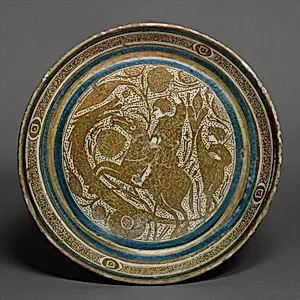
Bowl with a Horseman Spearing a Serpent
Unknown Artist
late 1300s or early 1400s
Medium
Tin-glazed earthenware
Dimensions
Overall: 3 5/8 x diam. 17 5/16 in. (9.2 x diam. 44 cm) depth of dish: 3 in. (7.6 cm)
Classification
Ceramics
Culture
Spanish
Department
Medieval Art
Museum
Metropolitan Museum of Art, New York, NY
Credit
Gift of George Blumenthal, 1941
Accession Number
41.100.173
Rights
Public Domain
Tags
Art Historical Context
This stunning tin-glazed earthenware bowl crafted in Spain during the late 130s or early 1400s, captures a dramatic scene of a horseman spearing a serpent. Measuring about 17 inches in diameter with a 3-inch depth, it's prime example of medieval ceramics designed for both practical use and display. The central motif—evoking themes of heroism and combat against chaos—features a dynamic rider on horseback, lance poised, surrounded by motifs of men, horses, and hunting, common in the era's decorative arts. Tin-glazing, a technique introduced to Spain via Islamic influences during the medieval period, gives the bowl its luminous, enamel-like surface, allowing vibrant colors and intricate details to shine through. Produced in workshops like those in Manises or Valencia, these pieces blended Christian and Moorish styles amid the Reconquista, reflecting Spain's cultural crossroads. As a functional yet ornamental object, it likely graced noble tables, symbolizing chivalric valor. Today, this bowl resides in the Metropolitan Museum of Art's Medieval Art department, a generous 1941 gift from George Blumenthal. It offers a window into late medieval life, where everyday ceramics told epic tales of triumph.