
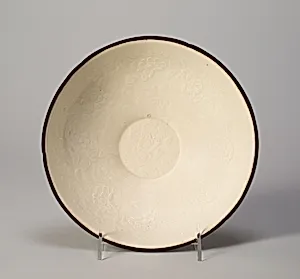
Bowl with Boys Playing amid Peony Flowers
Jin dynasty (1115–1234), 12th century
Medium
Ding ware; porcelain with underglaze mold-impressed decoration; metal rim
Dimensions
6.2 × 21.2 cm (2 7/16 × 8 3/8 in.); Diam.: 21.2 cm (8 3/8 in.)
Classification
bowl
Department
Arts of Asia
Museum
Art Institute of Chicago
Accession Number
65892
Rights
Public Domain
Art Historical Context
Nestled in the Art Institute of Chicago's Arts Asia collection, this delicate *Bowl with Boys Playing amid Peony Flowers* exemplifies the pinnacle of Jin dynasty (1115–1234) porcelain artistry from 12th-century China. Crafted in renowned Ding ware—a translucent, ivory-white porcelain fired at kilns in northern Hebei province—the bowl measures just 6.2 × 21.2 cm, its slender form highlighting the era's mastery of thin potting. A protective metal rim encircles the mouth, a practical feature for these finely made vessels often used in elite dining. The bowl's underglaze mold-impressed decoration reveals lively boys frolicking amid blooming peonies, pressed into the clay before glazing and firing. This innovative technique allowed for intricate, repeatable motifs while preserving the porcelain's luminous surface, making Ding ware highly prized domestically and abroad. Peonies, symbols of prosperity and springtime abundance in Chinese culture, frame the playful children, evoking themes of joy, fertility, and harmony between humans and nature. During the Jin dynasty—a turbulent period under Jurchen rule amid Mongol threats—such ceramics represented cultural refinement and technical innovation, bridging Song dynasty elegance with later Yuan styles. This bowl invites visitors to appreciate not just its beauty, but the enduring legacy of Chinese porcelain craftsmanship.
About the Artist
Unknown
The artist designated as "Unknown" in our virtual museum's collection exemplifies a poignant chapter in art history: creators whose identities have faded into obscurity despite the enduring power of their work. With only one known artwork attributed to them in our holdings, this figure represents countless anonymous hands that shaped visual culture across centuries. Museums worldwide, including th...