
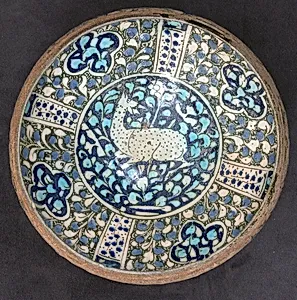
Bowl with Deer Motif
Unknown Artist
14th century
Medium
Stonepaste; underglaze painted (Sultanabad ware)
Dimensions
H. 4 3/8 in. (11.1 cm) Diam. 7 7/8 in. (20 cm)
Classification
Ceramics
Department
Islamic Art
Museum
Metropolitan Museum of Art, New York, NY
Credit
H.O. Havemeyer Collection, Gift of Horace Havemeyer, 1941
Accession Number
41.165.43
Rights
Public Domain
Tags
Art Historical Context
This bowl presents a striking central medallion in which a white deer, its body dotted with blue, stands amid curling turquoise foliage against a deep blue ground. The surrounding border is divided into panels of stylized blue and turquoise flowers linked by slender white stems, alternating with narrow vertical bands filled with rows of small blue dots. The palette is limited to cool blues, greens, and whites, applied in underglaze colors on a pale stonepaste body whose slightly worn rim reveals the material beneath. Created in the fourteenth century by an unknown artist, the bowl belongs to the group known as Sultanabad ware, a distinctive type of Persian ceramic prized for its lively animal and plant motifs. The Metropolitan Museum’s example entered the collection as part of the H. O. Havemeyer gift in 1941 and remains a fine illustration of the refined underglaze technique practiced in medieval Iran. Its compact size and balanced decoration would have made it both practical and pleasing on a table or in a niche.