
Bowl
Unknown Artist
19th century
Medium
Stonepaste; painted in blue and black under transparent glaze
Dimensions
H. 3 3/4 in. (9.5 cm) Diam. 8 1/2 in. (19.1 cm) Wt. 21.9 oz. (620.9 g)
Classification
Ceramics
Department
Islamic Art
Museum
Metropolitan Museum of Art, New York, NY
Credit
Rogers Fund, 1908
Accession Number
08.102.8
Rights
Public Domain
Art Historical Context
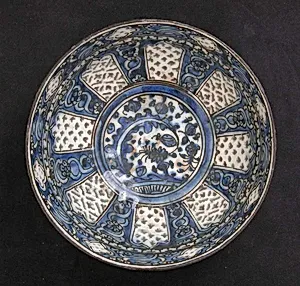
The bowl presents a harmonious circular composition viewed from above, its interior divided into a central medallion and eight radiating panels. Deep cobalt blue and softer black tones define scrolling floral motifs in the center, while the surrounding sections alternate between dense dotted textures and delicate vine patterns. A border of stylized waves encircles the rim, all rendered beneath a clear glaze that lends a subtle sheen to the stonepaste surface. Created in the nineteenth century by an unknown artist working in the Islamic ceramic tradition, this vessel demonstrates the continued refinement of underglaze painting techniques. The medium—stonepaste decorated in blue and black beneath a transparent glaze—allowed artisans to achieve crisp, luminous designs that remained popular across the region long after earlier periods. Acquired by the Metropolitan Museum of Art through the Rogers Fund in 1908, the bowl offers visitors a tangible connection to the everyday artistry of its time. Its balanced palette and intricate yet legible patterns invite close looking, revealing the skill involved in shaping both form and ornament.