
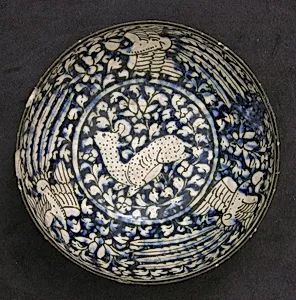
Bowl with Deer and Phoenix Motifs
Unknown Artist
first half 14th century
Medium
Stonepaste; blue and black painted under transparent glaze (Sultanabad ware)
Dimensions
H. 2 3/4 in. (7 cm) Diam. 6 5/8 in. (16.8 cm)
Classification
Ceramics
Department
Islamic Art
Museum
Metropolitan Museum of Art, New York, NY
Credit
Rogers Fund, 1970
Accession Number
1970.27
Rights
Public Domain
Tags
Art Historical Context
This elegant ceramic bowl draws the eye with its harmonious circular design. At the center, a spotted deer stands amid delicate floral vines within a blue-bordered medallion. Along the curving walls, three stylized phoenixes with outstretched wings appear against a dense pattern of blossoms and leaves, all painted in varying shades of cobalt blue and black beneath a clear glaze that gives the surface a soft sheen. Created in the first half of the fourteenth century, the bowl belongs to a group known as Sultanabad ware, produced in the Islamic world using stonepaste. The unknown artist employed the characteristic technique of painting in blue and black under the transparent glaze, allowing the motifs to glow with subtle depth. Such vessels combined everyday function with rich symbolic imagery, where real and mythical creatures like the deer and phoenix evoked themes of nature and renewal. Today in the Metropolitan Museum’s collection of Islamic art, this compact bowl offers visitors a window into the refined ceramic traditions of its time. Its balanced composition and luminous palette continue to reward close looking, revealing the skill of medieval potters who turned simple clay into objects of lasting beauty.