
Box
1753–76
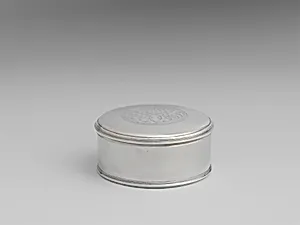
Medium
Silver
Dimensions
Overall: 1 11/16 x 3 9/16 in. (4.3 x 9 cm); 5 oz. 15 dwt. (179.1 g) Body: 3 oz. 12 dwt. (111.4 g) Cover: 2 oz. 4 dwt. (67.7 g)
Classification
Box
Culture
American
Department
The American Wing
Museum
Metropolitan Museum of Art, New York, NY
Credit
Bequest of Alphonso T. Clearwater, 1933
Accession Number
33.120.139a, b
Rights
Public Domain
Art Historical Context
This exquisite silver box, crafted by Elias Pelletreau between 1753 and 1776, exemplifies the finest colonial American silversmithing. Pelletreau, a prominent artisan based in Southampton, New York, was renowned for his skilled work in the Rococo style, blending European influences with American ingenuity. Working during the mid-18th century—a time of growing colonial prosperity—this compact piece (just 1⅞ x 3½ inches and weighing nearly 6 ounces) would have served as a luxurious personal accessory, perhaps for holding snuff, patches, or pills, symbolizing the owner's refined taste and social standing. The box's construction highlights masterful silversmith techniques: the body and hinged cover are meticulously hammered and seamed from high-purity silver, showcasing Pelletreau's precision in chasing, engraving, and polishing. Such objects were rare and costly in the American colonies, where silver was imported or recycled, making Pelletreau's output a hallmark of pre-Revolutionary craftsmanship. Housed in The Metropolitan Museum of Art's American Wing, it entered the collection through the 1933 bequest of Alphonso T. Clearwater, preserving a tangible link to everyday elegance in early America. Visitors will appreciate how this unassuming "Box" reflects the artistry of a self-taught master whose pieces rivaled those from London workshops, bridging Old World traditions with New World ambition.