
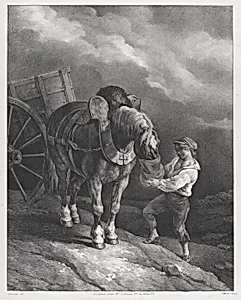
Boy Feeding a Cart Horse from a Nose Bag
Medium
Lithograph
Dimensions
sheet: 22 3/4 x 16 3/4 in. (57.8 x 42.5 cm) plate: 16 7/16 x 13 1/16 in. (41.7 x 33.1 cm)
Classification
Prints
Department
Drawings and Prints
Museum
Metropolitan Museum of Art, New York, NY
Credit
Rogers Fund, 1920
Accession Number
20.17.13
Rights
Public Domain
Tags
Art Historical Context
In the heart of French Romanticism, Théodoreéricault captures a tender moment of everyday life in *Boy Feeding a Cart Horse a Nose Bag* (1822), a lithograph from the Metropolitan Museum of Art Drawings and Prints collection.éricault, famed for his dramatic history paintings like *The Raft the Medusa* (9), turned his keen eye to horses and human-animal bonds throughout his career. This print, measuring about 16 x 13 inches on the plate, reflects his fascination with equine anatomy and motion, drawn from direct observation at Paris stables and racetracks. Lithography, a revolutionary medium Géricault helped popularize in the 1820s, allowed for rich tonal effects and fluid lines impossible in earlier print techniques. By drawing with greasy crayon on a prepared limestone block, he achieved a painterly realism that blurred the line between drawing and painting—perfect for intimate studies like this one, where the boy's gentle focus and the horse's patient munching evoke quiet dignity amid urban toil. Acquired through the Rogers Fund in 1920, this work highlights 19th-century working-class life in France, blending Romantic emotional depth with documentary precision. It's a window into Géricault's innovative printmaking, inviting visitors to appreciate the artistry in the ordinary.
About the Artist
Théodore Gericault · 1791–1824
Théodore Géricault, born Jean-Louis André Théodore Géricault on September 26, 1791, in Rouen, France, into a prosperous family—his father a lawyer turned tobacco merchant and his mother from a line of growers—moved to Paris around 1797. Displaying early artistic promise, recognized by painter Jean-Louis Laneuville, he began formal training in 1808 under Carle Vernet, mastering English sporting art...