
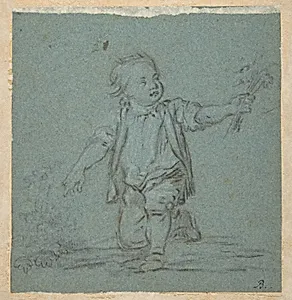
Boy Holding Flowers
18th century
Medium
Black and white chalk on blue paper
Dimensions
5 7/8 x 5 1/2 in. (15 x 14 cm)
Classification
Drawings
Department
Drawings and Prints
Museum
Metropolitan Museum of Art, New York, NY
Credit
Bequest of Julia H. Manges, in memory of her husband, Dr. Morris Manges, 1960
Accession Number
60.88.2
Rights
Public Domain
Tags
Art Historical Context
In the intimate world of 18th French drawings, *Boy Holding Flowers* captures a fleeting moment of youthful energy. Created anonymously by a French artist during this elegant era, the work depicts a boy in motion—likely running—clutching a bouquet of, evoking the Rococo spirit of playfulness and pastoral charm. At just 5 7/8 x 5 1/2 inches (15 x 14 cm), its small scale suggests it was a preparatory sketch or personal study, for its spontaneity rather than grand display. Rendered in black and white chalk on blue prepared paper, the medium highlights the artist's mastery of light and shadow. The toned blue ground lends a luminous depth, allowing the white chalk to pop as highlights on the boy's dynamic form and the delicate flowers, while black chalk defines contours with fluid precision. This technique, popular among French draftsmen like Watteau or Fragonard contemporaries, bridged studio preparation and finished artistry, reflecting the period's emphasis on observation from life. Now housed in the Metropolitan Museum of Art's Drawings and Prints department, thanks to the 1960 bequest of Julia H. Manges in memory of her husband, Dr. Morris Manges, this gem invites us to ponder everyday joys amid the opulence of ancien régime France. A reminder that even anonymous hands could immortalize innocence and nature's fleeting beauty.
About the Artist
Anonymous, French, 18th century · 1700–1800
The artist known as Anonymous, French, 18th century, represents a collective of unidentified talents active roughly between 1700 and 1800, a period of profound artistic evolution in France from the opulent Rococo to the austere dawn of Neoclassicism and Revolutionary fervor. Little is documented about their personal training or mentors, as their anonymity obscures individual biographies, though th...