
Boy's Baijia Pao ("One Hundred Household" Robe)
Qing dynasty (1644–1911), 1850/1900
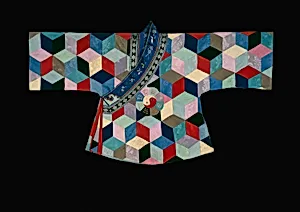
Medium
Silk, warp-float faced 3:1 'Z' twill weaves self-patterned by areas of plain weave; pieced; medallions with under drawing in black pigment and trimmed with cords of gold-leaf-over-lacquered-paper-strip-wrapped silk couched with silk; neck facing: silk, warp-float faced 7:1 satin weave; embroidered in satin, single satin, and stem stitches; trimmed with braid of silk, 2:2 oblique interlacing and with ribbon of silk and cotton, warp-float faced 7:1 satin weave with supplementary patterning warps and self-patterned by main warp floats; ties: silk, warp-float faced 3:1 'Z' twill weave self-patterned by areas of plain weave; lined with silk, plain weave
Dimensions
65 × 114.6 cm (25 5/8 × 45 1/8 in.)
Classification
textile
Department
Textiles
Museum
Art Institute of Chicago
Accession Number
150152
Rights
Public Domain
About the Artist
Han-Chinese
**Han-Chinese** was the collective attribution given to anonymous artisans of Han Chinese descent who crafted intricate embroidered textiles during the Qing dynasty (1644–1911). These makers, active primarily in the late 18th to early 20th centuries, specialized in luxurious garments and furnishings that showcased the pinnacle of Han Chinese needlework traditions. Their early lives and individual ...