
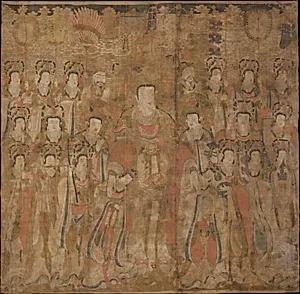
작자미상 범천왕을 중심으로 한 신중도 조선|作者未詳 神衆圖 朝鮮|Brahma with Attendants and Musicians
late 16th century
Medium
Hanging scroll; ink and color on hemp
Dimensions
Image: 85 × 87 in. (215.9 × 221 cm) Overall with mounting: 132 × 97 in. (335.3 × 246.4 cm) Overall with knobs: 132 × 101 3/4 in. (335.3 × 258.4 cm)
Classification
Paintings
Culture & Period
Korea · Joseon dynasty (1392–1910)
Department
Asian Art
Museum
Metropolitan Museum of Art, New York, NY
Credit
Gift of Mrs. Edward S. Harkness, 1921
Accession Number
21.57
Rights
Public Domain
Tags
Art Historical Context
This stunning hanging scroll, titled *Brahma with Att and Musicians* (신중도), dates to the late 16 century during Korea's Joseon dynasty (1392–1910). Created by an unidentified artist using ink and vivid colors on hemp, it measures an impressive 85 × 87 inches, designed for dramatic display in temples or ritual spaces. At its center stands Brahma (범천왕), the Hindu god adopted into Korean Buddhism as a guardian deity, surrounded by a lively assembly of attendants, musicians, and figures playing traditional instruments—evident in the painting's tags highlighting musical motifs. In Joseon Korea, where Neo-Confucianism dominated elite culture, folk Buddhist art like this Shinjungdo (assembly of deities) thrived among commoners and in shamanistic practices. These works visualized protective celestial beings, invoking divine aid for prosperity and warding off evil. The large scale and dynamic composition reflect vernacular techniques: bold outlines in ink, layered mineral pigments for vibrancy, and a crowded yet harmonious scene typical of hemp-scroll paintings, which were portable yet monumental. A gift to the Metropolitan Museum of Art in 1921, this piece offers a window into Joseon's spiritual undercurrents, blending Indian, Chinese, and Korean influences in a joyous celebration of music and divinity. Visitors will appreciate its rhythmic energy, as if the musicians' melodies still echo through the gallery.