
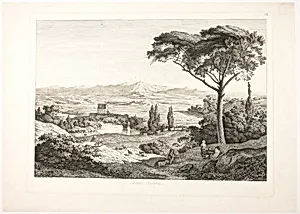
Bridge of Salaro
Medium
Etching on paper
Dimensions
Image: 24.5 × 35.6 cm (9 11/16 × 14 1/16 in.); Plate: 28 × 38 cm (11 1/16 × 15 in.); Sheet: 32.9 × 45.2 cm (13 × 17 13/16 in.)
Classification
etching
Department
Prints and Drawings
Museum
Art Institute of Chicago
Accession Number
153611
Rights
Public Domain
Art Historical Context
### Bridge of Salaro Visitors to the Art Institute of Chicago's Prints Drawings department will discover *Bridge of Salaro* (1793), a delicate etching on paper by German artist Jacob Wilhelm Mechau1746–1808). Measuring 24.5 × 35.6 cm in its image area, this work captures a picturesque Roman countryside scene, likely featuring the ancient Ponte Salaro Frascati, Italy—a site beloved by 18th-century on the Grand Tour. Mech, who settled in Rome in 1784 after training in Düsseldorf and Kassel, specialized in such landscapes, blending precise observation with a sense of timeless natural beauty. As an etching, the piece showcases Mechau's mastery of intaglio printing, where acid bites into a metal plate to create fine, expressive lines that convey texture, light, and depth on paper. This medium was ideal for reproducing detailed views affordably, allowing wider appreciation of Italy's classical ruins amid the Enlightenment's fascination with antiquity and nature. Mechau's style bridges Neoclassicism and emerging Romanticism, emphasizing harmonious compositions over dramatic emotion. This artwork reflects the era's cultural pilgrimage to Italy, inviting us to pause and appreciate how a simple bridge could symbolize enduring human ingenuity against nature's grandeur. A gem for print enthusiasts! *(198 words)*
About the Artist
Jacob Wilhelm Mechau · 1745–1808
Jacob Wilhelm Mechau (1745–1808) was a German painter and draughtsman who became one of the more distinctive landscape artists working in Rome during the late eighteenth century. Born in Dresden in 1745, Mechau received his early artistic education in the rich environment of that city's court culture, which placed a high premium on classical training and technical refinement. He later made his way...