
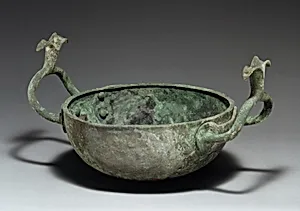
Bronze bowl with handles terminating in lotuses
Unknown Artist
ca. 850–750 BCE
Medium
Bronze
Dimensions
H. 5 7/8 in. (15 cm) H. with handles 10 5/8 in. (27 cm) diameter 13 5/8 in. (34.6 cm)
Classification
Bronzes
Culture & Period
Cypriot · Cypro-Geometric III
Department
Greek and Roman Art
Museum
Metropolitan Museum of Art, New York, NY
Credit
The Cesnola Collection, Purchased by subscription, 1874–76
Accession Number
74.51.5673
Rights
Public Domain
Art Historical Context
This elegant bronze bowl, crafted by an unknown Cypriot artisan around 850–750 BCE during the Cypro-Geometric period, exemplifies the island's vibrant metalworking tradition. Standing 5⅞ inches tall (with handles rising to 10⅝ inches) and measuring 13⅝ inches across, it sturdy handles that gracefully terminate in lotus motifs—a nod to Eastern Mediterranean influences from Egypt and the Near East, where the lotus symbolized rebirth and purity. Cyprus, a bustling trade crossroads between Greece, Phoenicia, and Anatolia, produced such vessels for elite use in rituals, feasting, or as grave goods. The bowl's bronze medium highlights advanced casting techniques of the era, where molten metal was poured into molds to create durable, functional art. Cypro-Geometric III style emphasized geometric patterns and stylized flora on pottery and bronzes, blending local innovation with foreign inspirations amid Cyprus's shift to the Iron Age. Though undecorated on the body, the handles' organic lotus forms add a touch of naturalism, showcasing the period's evolving aesthetic. Acquired through The Cesnola Collection at The Metropolitan Museum of Art, this piece offers a window into ancient Cyprus's cultural melting pot, reminding us how everyday objects carried profound symbolic weight in a connected ancient world.