
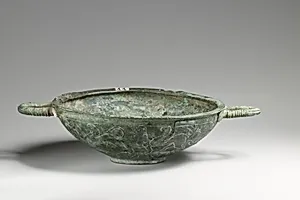
Bronze kylix (cup)
Unknown Artist
7th century BCE
Medium
Bronze
Dimensions
H. 2 3/8 in. (6 cm); diameter 6 7/8 in. (17.4 cm)
Classification
Bronzes
Culture & Period
Etruscan · Late Geometric
Department
Greek and Roman Art
Museum
Metropolitan Museum of Art, New York, NY
Credit
Rogers Fund, 1909
Accession Number
09.221.21
Rights
Public Domain
Tags
Art Historical Context
This exquisite bronze kylix, or shallow drinking cup, hails from Etruscan culture in the Late Geometric period of the 7th century BCE. Crafted by an unknown artist, it stands just 2⅜ inches tall with a 6⅞-inch diameter, making it a delicate yet functional vessel likely used in elite banquets or rituals. Acquired through the Rogers Fund in 1909, it now graces the Greek and Roman Art department at the Metropolitan Museum of Art, exemplifying the sophisticated metalworking of pre-Roman Italy. The cup's surface features incised or repoussé decorations of mythical sphinxes, goats, and lions—hallmarks of Geometric art's stylized animal motifs. These creatures, rendered in linear patterns with angular forms, reflect Etruscan adoption of Greek influences while asserting local vitality. Bronze, a prized alloy of copper and tin, was hammered and chased to create its gleaming finish, showcasing advanced techniques that symbolized wealth and status. As a window into Etruscan daily life and artistry, this kylix highlights a vibrant society bridging Eastern Mediterranean styles with Italic traditions. Its motifs evoke protection and power, inviting us to imagine ancient hands raising it in toast amid flickering torchlight.