
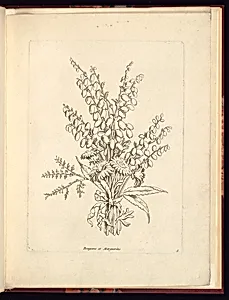
Bruyeres et Marguerites
Classification
Department
Smithsonian Collection
Museum
Smithsonian American Art Museum
Credit
Purchased for the Museum by the Advisory Council
Accession Number
1921-6-498-5
Rights
Public Domain
About this artwork
Research in Progress
Art Historical Context
**Bruyères et Marguerites** is a delicate print created by Charles-Germain de Saintubin, a prominent French engraver and illustrator (1721–1786), between 1757 and 1768. Saint-Aubin, part of a talented family of artists, was renowned for his intricate rococo-style works that captured the elegance of 18th-century French life, often blending whimsy with technical precision. This piece, housed in the Smithsonian American Art's Smithsonian Collection, was acquired through the Advisory Council's purchase, highlighting its enduring appeal to collectors. The title translates to "Heathers and Daisies," a botanical focus typical of the era's fascination with nature during the Enlightenment. As a print—likely an etching or engraving— it exemplifies the period's advancements in reproductive techniques, allowing detailed floral studies to be widely shared for both scientific study and decorative use. Rococo artists like Saint-Aubin infused such works with graceful lines and lively textures, turning simple flowers into celebrations of beauty and transience. Though research on this specific print is ongoing, it reflects the cultural vogue for floral imagery in pre-Revolutionary France, where such motifs adorned everything from fashion to furnishings. Visitors will appreciate its timeless charm, a window into an age of refined artistry and natural curiosity.