
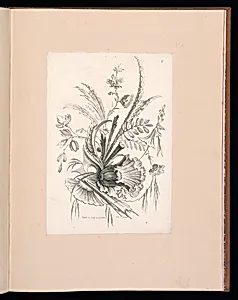
Floral Ornament Design
Classification
Bound print
Department
Smithsonian Collection
Museum
Smithsonian American Art Museum
Credit
Purchased for the Museum by the Advisory Council
Accession Number
1921-6-213-18
Rights
Public Domain
About this artwork
Research in Progress
Art Historical Context
Gabriel Huquier's *Floral Ornament Design created between 1738 and 1749, exemplifies the exuberant Rococo style that flourished in mid-18th-century France As a prominent engraver and print publisher, Huquier (1695–1772) specialized reproducing intricate ornamental motifs inspired by contemporaries like Antoine Watteau. This bound print, part of the Smithsonian American Art Museum's collection, likely served as a pattern source for artisans crafting furniture, wallpapers, and silverwork, capturing the era's love for delicate flowers, scrolling vines, and playful asymmetry. Rococo designs like this one marked a shift from the grandeur of Baroque toward lighter, more intimate decoration, reflecting the refined tastes of the French aristocracy under Louis XV. Huquier's prints were widely disseminated across Europe, influencing decorative arts far beyond France. Though the exact medium remains unspecified amid ongoing research, its classification as a bound print suggests it hails from an album of engravings or etchings, prized for their precision and reproducibility. Acquired through the Museum's Advisory Council, this piece bridges European elegance with American collections, underscoring the global exchange of artistic ideas. Visitors will appreciate how such floral fantasies continue to inspire modern design, blooming with timeless charm.