
Buckle
Unknown Artist
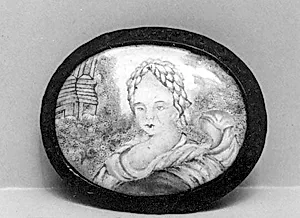
Medium
Painted enamel
Dimensions
H. 1 3/4 in. (4.4 cm); W. 1 3/8 in. (3.5 cm)
Classification
Enamels
Culture & Period
China · Qing dynasty (1644–1911), Qianlong period (1736–95)
Department
Asian Art
Museum
Metropolitan Museum of Art, New York, NY
Credit
Bequest of Mary Clark Thompson, 1923
Accession Number
24.80.459
Rights
Public Domain
Tags
Art Historical Context
This delicate painted enamel buckle, hailing from China's Qing dynasty during the Qianlong period (1736–95), exemplifies the era's masterful craftsmanship in personal adornments. Measuring just 1 3/4 inches high and 1 3/8 inches wide, it was likely worn as a fashionable accessory, possibly on a belt or robe, reflecting the refined tastes of imperial and elite society. The tag associating it with "Women" suggests it may have graced women's attire, highlighting gender-specific jewelry in 18th-century China. Painted enamel, a technique where finely ground glass colors are applied in layers and fired onto a metal base, allowed for vibrant, detailed designs that mimicked painting on porcelain. During the Qianlong reign, Emperor Qianlong's patronage spurred a golden age of enamel work, blending European influences from Jesuit missionaries with traditional Chinese motifs. This buckle's survival speaks to the durability and artistry of such objects, often featuring intricate scenes of nature, figures, or auspicious symbols. Housed in the Metropolitan Museum of Art's Asian Art Department through the 1923 bequest of Mary Clark Thompson, this piece offers a window into Qing opulence. Though its precise imagery remains unrecorded here, it invites visitors to ponder the wearer's status and the cultural fusion that defined the period's decorative arts.