
北魏太和十年 鎏金青銅彌勒佛像|Buddha Maitreya (Mile)
Unknown Artist
dated 486 (10th year of Taihe reign)
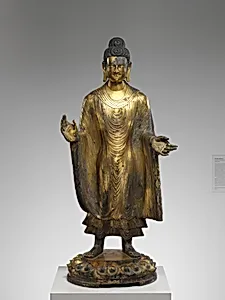
Medium
Gilt bronze with traces of pigment; piece-mold cast
Dimensions
H. 55 1/4 in. (140.3 cm); W. 24 1/2 in. (62.2 cm); D. 19 1/4 in. (48.9 cm)
Classification
Sculpture
Culture & Period
China · Northern Wei dynasty (386–534)
Department
Asian Art
Museum
Metropolitan Museum of Art, New York, NY
Credit
John Stewart Kennedy Fund, 1926
Accession Number
26.123
Rights
Public Domain
Tags
Art Historical Context
This imposing gilt bronze statue of Buddhaaitreya (known as Mile in Chinese) dates precisely to 486 CE, the 10th year of thehe reign during China's Northern Wei dynasty (386534). Standing over 55 inches tall, it is a monumental example of early Buddhist sculpture from northern China, created by an unknown artist using the ancient piece-mold casting technique.aces of pigment and gilding—gold leaf applied over the bronze—enhance its, divine presence, evoking the opulence of imperial patronage. The Northern Wei, a nomadic Xianbei-led regime, actively promoted Buddhism as a unifying force, fostering a golden age of religious art along the Silk Road. This Maitreya, the Buddha of the future in Mahayana tradition, reflects the dynasty's role in adapting Central Asian influences into distinctly Chinese forms, paving the way for later masterpieces at sites like Yungang and Longmen caves. Its precise dating via inscription underscores its rarity and historical value, offering insight into 5th-century metallurgy and devotion. Acquired through the John Stewart Kennedy Fund in 1926, it now graces the Metropolitan Museum of Art's Asian Art collection, inviting visitors to ponder the serene promise of enlightenment.