
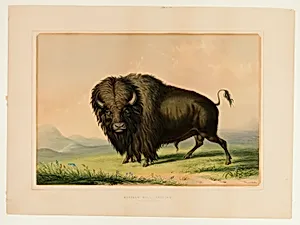
Buffalo Bull Grazing--no.2
Medium
Graphic Arts-Print
Classification
Graphic Arts-Print
Department
Smithsonian Collection
Museum
Smithsonian American Art Museum
Credit
Smithsonian American Art Museum, Transfer from the National Museum of Natural History, Department of Ethnology, Smithsonian Institution
Accession Number
1985.66.386,599B
Rights
Public Domain
Tags
Art Historical Context
George Catlin's *Buffalo Bull Grazingno. 2* captures the majestic wildlife of the American West, recurring theme in the artist's prolific body of work. As a pioneering 19th-century painter, Catlin (1796–1872) dedicated his career to documenting Native American cultures and the untamed landscapes of the Great Plains before they were forever altered by westward expansion. This graphic arts print, likely a reproduction of one of his on-site sketches or oil paintings, showcases a powerful buffalo bull in a serene grazing pose, evoking the vast, open prairies that defined frontier life. The artwork holds significant historical value as part of the Smithsonian American Art Museum's collection, transferred from the National Museum of Natural History's Department of Ethnology. Buffalo, or bison, were not just wildlife but the lifeblood of Plains Indian tribes—providing food, shelter, clothing, and spiritual sustenance. Catlin's detailed renderings, often created during his travels among tribes in the 1830s, aimed to preserve these scenes for posterity amid rapid environmental and cultural changes. As a print medium, it made his observations accessible to a wider audience, amplifying their educational impact. Today, this piece invites visitors to reflect on America's natural heritage and the artist's urgent mission to chronicle a disappearing world. Its landscape tag underscores Catlin's masterful blend of realism and romanticism, drawing us into the wild heart of the continent.
About the Artist
George Catlin · 1796–1872
George Catlin (1796–1872), born in Wilkes-Barre, Pennsylvania, to Putnam Catlin and Polly Sutton—who had been captured by Native Americans during the 1778 Battle of Wyoming—initially pursued a legal career. Trained at Litchfield Law School, he was admitted to the bar in 1819 but abandoned law after two years to study art in Philadelphia in 1823. Self-taught as a portraitist, Catlin quickly gained ...