
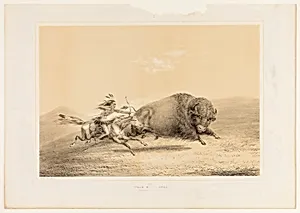
Buffalo Hunt, Chase--no. 5
Medium
Graphic Arts-Print
Classification
Graphic Arts-Print
Department
Smithsonian Collection
Museum
Smithsonian American Art Museum
Credit
Smithsonian American Art Museum, Transfer from the National Museum of Natural History, Department of Ethnology, Smithsonian Institution
Accession Number
1985.66.386,590E
Rights
Public Domain
Tags
Art Historical Context
George Catlin's *Buffalo Hunt, Chase. 5* captures the raw drama of Plains Indian life in the 19th century, part of the artist's monumental effort to document Native American cultures before they were forever altered by westward expansion. A pioneering ethnographer and painter, Catlin journeyed across the American West in the 1830s, sketching and painting indigenous peoples and their traditions firsthand. This graphic arts print, likely a lithograph derived from his field sketches or oil paintings, depicts a thrilling buffalo chase with a male hunter in pursuit, set against a sweeping landscape—evoking the vast prairies where these hunts were essential for survival, providing food, clothing, and tools. As the fifth in a series, the work highlights Catlin's realistic style, blending journalistic precision with romantic energy to immerse viewers in the hunt's intensity. Buffalo were the lifeblood of tribes like the Sioux and Blackfeet, and Catlin's images preserve these rituals amid the looming threat of extinction from overhunting and settlement. Housed in the Smithsonian American Art Museum, this print underscores his legacy: over 600 works forming a visual archive of a fading world, educating generations on cultural heritage and environmental interconnectedness.
About the Artist
George Catlin · 1796–1872
George Catlin (1796–1872), born in Wilkes-Barre, Pennsylvania, to Putnam Catlin and Polly Sutton—who had been captured by Native Americans during the 1778 Battle of Wyoming—initially pursued a legal career. Trained at Litchfield Law School, he was admitted to the bar in 1819 but abandoned law after two years to study art in Philadelphia in 1823. Self-taught as a portraitist, Catlin quickly gained ...