
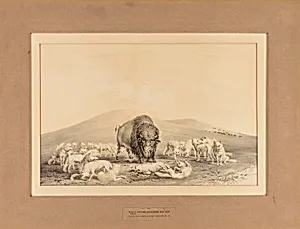
White Wolves Attacking Old Buffalo--no. 10
Medium
Graphic Arts-Print
Classification
Graphic Arts-Print
Department
Smithsonian Collection
Museum
Smithsonian American Art Museum
Credit
Smithsonian American Art Museum, Transfer from the National Museum of Natural History, Department of Ethnology, Smithsonian Institution
Accession Number
1985.66.386,590I
Rights
Public Domain
Tags
Art Historical Context
George Catlin, a pioneering 19th-century American artist, captured the raw drama of the American West through his vivid depictions of Native American life and wildlife. Best known for his extensive travels among Plains tribes in the 183s, Catlin created thousands of works to document a vanishing frontier before westward expansion transformed it forever. *White Wolves Attacking Old Buffalo--. 10*, a graphic arts print from the Smithsonian American Museum's collection, exemplifies his fascination with the perilous natural world of the Great Plains, where predators and prey clashed in epic struggles for survival. This dynamic scene portrays white wolves descending on a vulnerable old buffalo amid a rugged landscape, highlighting the brutal balance of nature that sustained indigenous hunters. As part of a numbered series, it reflects Catlin's meticulous observation of animal behavior during his expeditions. Rendered as a print—likely a lithograph or engraving derived from his oil paintings—the medium allowed wide dissemination of his images, educating Eastern audiences about the West's untamed wilderness and influencing public perceptions of American expansion. Housed in the Smithsonian's collection (transferred from the National Museum of Natural History), this artwork underscores Catlin's role as a visual chronicler, blending Romantic realism with ethnographic insight to preserve moments of primal intensity for future generations.
About the Artist
George Catlin · 1796–1872
George Catlin (1796–1872), born in Wilkes-Barre, Pennsylvania, to Putnam Catlin and Polly Sutton—who had been captured by Native Americans during the 1778 Battle of Wyoming—initially pursued a legal career. Trained at Litchfield Law School, he was admitted to the bar in 1819 but abandoned law after two years to study art in Philadelphia in 1823. Self-taught as a portraitist, Catlin quickly gained ...