
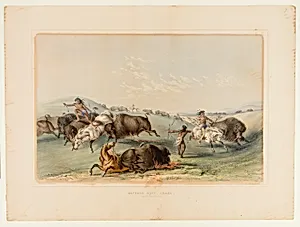
Buffalo Hunt, Chase No. 7
Medium
Graphic Arts-Print
Classification
Graphic Arts-Print
Department
Smithsonian Collection
Museum
Smithsonian American Art Museum
Credit
Smithsonian American Art Museum, Transfer from the National Museum of Natural History, Department of Ethnology, Smithsonian Institution
Accession Number
1985.66.386,599E
Rights
Public Domain
Tags
Art Historical Context
**Buffalo Hunt, Chase. 7** by George Catlin captures the intensity of a Plains Indian buffalo chase, a scene central to Native American life on the Great Plains. Catlin, a 19th-century American artist renowned for his ethnographic portraits and landscapes, traveled extensively among tribes in the 1830s, documenting their customs before widespread settlement altered their world. This print depicts a dynamic group of hunters pursuing buffalo across a vast landscape, highlighting the skill, speed, and communal spirit essential to these hunts. As a graphic arts print from the Smithsonian American Art Museum's collection—transferred from the National Museum of Natural History—this work reflects Catlin's mission to preserve Indigenous cultures through art. Prints like this one made his vivid oil paintings accessible to a wider audience, disseminating images of buffalo hunts that symbolized survival, sustenance, and spiritual rituals for tribes like the Sioux and Blackfeet. The medium's reproducibility amplified its cultural impact, educating Eastern viewers about the West's vanishing frontier. Though the exact date is unknown, the artwork's tags—buffalo, figure group, Indian, landscape, hunter—evoke the raw energy of the chase, where riders on horseback closed in on thundering herds. Catlin's realistic style blends documentary precision with dramatic composition, inviting us to reflect on a pivotal era in American history.
About the Artist
George Catlin · 1796–1872
George Catlin (1796–1872), born in Wilkes-Barre, Pennsylvania, to Putnam Catlin and Polly Sutton—who had been captured by Native Americans during the 1778 Battle of Wyoming—initially pursued a legal career. Trained at Litchfield Law School, he was admitted to the bar in 1819 but abandoned law after two years to study art in Philadelphia in 1823. Self-taught as a portraitist, Catlin quickly gained ...