
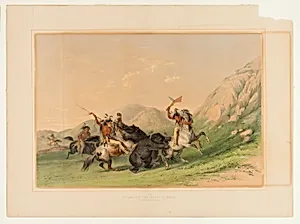
Attacking the Grizzly Bear--no. 19
Medium
Graphic Arts-Print
Classification
Graphic Arts-Print
Department
Smithsonian Collection
Museum
Smithsonian American Art Museum
Credit
Smithsonian American Art Museum, Transfer from the National Museum of Natural History, Department of Ethnology, Smithsonian Institution
Accession Number
1985.66.386,599N
Rights
Public Domain
Tags
Art Historical Context
Step into the wild frontier with George Catlin's *Attacking the Grizzly Bear--. 19*, a dynamic graphic arts print from the Smithsonian American Museum's collection. This vivid scene captures a tense moment of equestrian prowess, where Native American hunters on horseback confront a massive grizzly bear using axes and spears. The composition pulses with action, grouping figures in a dramatic clash that highlights human bravery against nature's fiercest predator. Catlin, a pioneering 19th-century American artist dedicated his career to documenting Native American life and the untamed West through paintings and prints like this one—part of his extensive Indian Gallery series. By reproducing his oil sketches as affordable prints, he brought these vanishing cultures to a wide audience, preserving scenes of Plains Indian hunters in their element before westward expansion forever altered their world. Though the exact date is unknown, it reflects Catlin's romantic yet realistic style, blending ethnographic accuracy with thrilling narrative. This print not only showcases masterful printmaking techniques for mass dissemination but also underscores the cultural significance of grizzly bear hunts in Indigenous traditions—symbols of courage and survival. A window into America's mythic past, it invites us to reflect on the artistry and resilience of those who roamed the plains. (198 words)
About the Artist
George Catlin · 1796–1872
George Catlin (1796–1872), born in Wilkes-Barre, Pennsylvania, to Putnam Catlin and Polly Sutton—who had been captured by Native Americans during the 1778 Battle of Wyoming—initially pursued a legal career. Trained at Litchfield Law School, he was admitted to the bar in 1819 but abandoned law after two years to study art in Philadelphia in 1823. Self-taught as a portraitist, Catlin quickly gained ...