
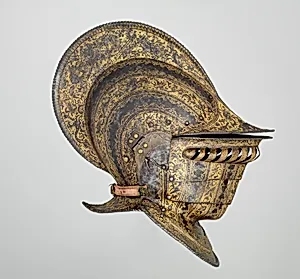
Burgonet with Buffe
Unknown Artist
ca. 1555–60
Medium
Steel, gold, leather, textile
Dimensions
H. 13 3/4 in. (34.9 cm); H. of comb 3 in. (7.6 cm); W. 9 1/4 in. (23.5 cm); D. 15 in. (38.1 cm); Wt. 6 lb. 6 oz. (2892 g)
Classification
Helmets
Culture
Italian
Department
Arms and Armor
Museum
Metropolitan Museum of Art, New York, NY
Credit
Gift of William H. Riggs, 1913
Accession Number
14.25.613
Rights
Public Domain
Art Historical Context
Step into the riveting world of Renaissance warfare with this exquisite *Burgonet with Buffe crafted in Italy around 1555–60. A burgonet was a lightweight, open-faced helmet favored by cavalrymen for its balance of protection and mobility during the dynamic battles of the16th century. The attached buffe—a pivoting lower guard for the chin and cheeks—added vital defense without sacrificing visibility, making it ideal for the fast-paced skirmishes of the Italian Wars. Forged from steel and adorned with gold, this helmet showcases the masterful metalworking of Italian armories, likely from renowned centers like Milan. The luxurious gold accents, combined with leather and textile linings for comfort, elevated it beyond mere utility into a status symbol for nobility. Weighing a sturdy 6 pounds 6 ounces, its precise dimensions (height 13¾ inches) reflect ergonomic design for prolonged wear under helmet plumes and crests. A generous gift from William H. Riggs in 1913, this piece at the Metropolitan Museum of Art highlights the fusion of artistry and armament in Renaissance Europe, where armorers were celebrated sculptors in steel. Imagine a condottiero charging into battle, his burgonet gleaming—a testament to Italy's enduring legacy in arms and armor.