
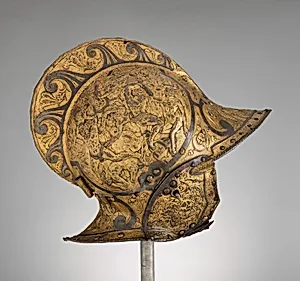
Burgonet with Falling Buffe
Unknown Artist
ca. 1550
Medium
Steel, gold
Dimensions
H. 14 in. (35.6 cm); W. 8 1/4 in. (21 cm); D. 14 1/4 in. (36.2 cm); Wt. 5 lb. 5 oz. (2404 g)
Classification
Helmets
Culture
French
Department
Arms and Armor
Museum
Metropolitan Museum of Art, New York, NY
Credit
burgonet: Rogers Fund, 1904; buffe: Purchase, Joseph Pulitzer Bequest, 1922
Accession Number
04.3.217; 22.140
Rights
Public Domain
Tags
Art Historical Context
Step into the riveting world of 16th-century warfare with this exquisite *Burgonet with Falling Buffe*, a helmet crafted around 1550. Made of polished steel inlaid with gleaming gold, it measures about 14 inches high and weighs over 5 pounds, embodying the perfect fusion of protection and prestige. The burgonet's open-faced design allowed for visibility and breathability on the battlefield, while the innovative falling buffe—a hinged, detachable visor—could be lowered for defense or raised for command, showcasing advanced engineering for elite warriors. Adorned with intricate gold decorations depicting fierce battles between men and mythical centaurs, this helmet transforms functional armor into a work of art. These etched motifs, drawn from classical mythology, reflect the Renaissance fascination with antiquity, evoking epic struggles from ancient lore amid the era's real conflicts, like France's Italian Wars. The gold accents not only enhanced its visual splendor for parades and tournaments but also signified the wearer's high status. Housed in the Metropolitan Museum of Art's Arms and Armor Department (acquired in 1904 and 1922), this piece highlights the masterful French metalworking techniques of the time—hammering, chasing, and gilding steel to create both beauty and lethality. A testament to the period's chivalric culture, it invites us to imagine a noble knight charging into legend.