
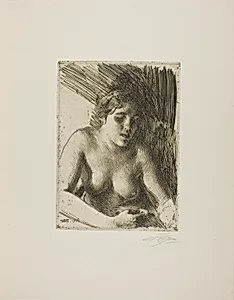
Bust
1916
Medium
Etching on ivory laid paper
Dimensions
Image/plate: 24.7 × 17.9 cm (9 3/4 × 7 1/16 in.); Sheet - folded: 44.1 × 34.7 cm (17 3/8 × 13 11/16 in.)
Classification
etching
Department
Prints and Drawings
Museum
Art Institute of Chicago
Accession Number
42331
Rights
Public Domain
Art Historical Context
Anders Zorn's *Bust* (1916) is a masterful etching that captures the Swedish artist's unparalleled skill in printmaking. Created during the later phase of Zorn's prolific career, this intimate portrait showcases his signature ability to render human form with lifelike immediacy. Zorn, a leading figure in late 19th- and early 20th-century European, was renowned for his portraits of prominent figures and everyday subjects, blending Realism with impressionistic light effects. Housed in the Art Institute of Chicago's Prints and Drawings department, the work measures 24.7 × 17.9 cm on ivory laid paper—a premium substrate that enhances the etching's subtle tonal range and creamy highlights. Etching, Zorn's preferred medium, involves incising lines into a metal plate with acid, allowing for delicate, velvety textures that mimic the luminosity of his oil paintings. Here, the technique shines in the bust's finely modulated surfaces, from the soft fall of fabric to the nuanced modeling of flesh. Printed on folded sheets of 44.1 × 34.7 cm, it exemplifies the intimate scale of fine art prints, making high artistry accessible beyond elite collectors. This 1916 piece reflects Zorn's enduring legacy amid World War I's shadows, offering a timeless celebration of human presence. Visitors will appreciate how it distills complex emotion into exquisite lines, a testament to etching's poetic power.
About the Artist
Anders Zorn · 1860–1920
Anders Zorn (1860–1920), one of Sweden's most celebrated artists, was born on February 18 in Utmeland near Mora in Dalarna, and raised on his maternal grandparents' farm in the nearby hamlet of Yvraden. Displaying prodigious talent from a young age, he attended school in Mora Strand until age twelve, followed by secondary grammar school in Enköping, where he excelled in drawing people and horses. ...