
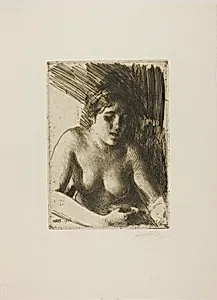
Bust
1916
Medium
Etching on ivory laid paper
Dimensions
Image/plate: 24.7 × 17.9 cm (9 3/4 × 7 1/16 in.); Sheet - folded: 43.2 × 32.3 cm (17 1/16 × 12 3/4 in.)
Classification
etching
Department
Prints and Drawings
Museum
Art Institute of Chicago
Accession Number
42333
Rights
Public Domain
Art Historical Context
Anders Zorn's *Bust* (1916) is a masterful etching on ivory laid paper, showcasing the Swedish artist's unparalleled skill in printmaking. Measuring 24.7 × 17.9 cm for the image and plate, this intimate portrait exemplifies Zorn's late-career prowess, created amid the tumult of World War I.oused in the Art Institute of Chicago's Prints Drawings department, it reflects Zorn's international reputation—he was a beloved portraitist who traveled extensively, including to the United States, where he captured luminaries with fluid realism. Zorn (1860–1920), a leading figure in Nordic art, blended academic precision with impressionistic vitality, earning acclaim for his etchings that rivaled paintings in luminosity. Etching allowed him to incise delicate lines into a metal plate with acid, producing velvety textures and subtle tonal gradations on the creamy ivory paper. In *Bust*, these techniques likely highlight the subject's form and expression with economical yet evocative strokes, a hallmark of Zorn's over 280 prints that prioritized psychological depth over ornamentation. This work underscores etching's democratic appeal in the early 20th century, making fine art accessible beyond oil canvases. Zorn's technical innovation and emotive power continue to captivate, inviting visitors to appreciate the quiet drama etched into every line.
About the Artist
Anders Zorn · 1860–1920
Anders Zorn (1860–1920), one of Sweden's most celebrated artists, was born on February 18 in Utmeland near Mora in Dalarna, and raised on his maternal grandparents' farm in the nearby hamlet of Yvraden. Displaying prodigious talent from a young age, he attended school in Mora Strand until age twelve, followed by secondary grammar school in Enköping, where he excelled in drawing people and horses. ...