
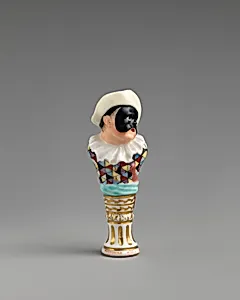
Bust of Harlequin
ca. 1770s
Medium
Soft-paste porcelain
Dimensions
Overall: 2 3/8 × 7/8 in. (6 × 2.2 cm)
Classification
Ceramics-Porcelain
Culture
British, Chelsea-Derby
Department
European Sculpture and Decorative Arts
Museum
Metropolitan Museum of Art, New York, NY
Credit
Gift of Irwin Untermyer, 1964
Accession Number
64.101.648
Rights
Public Domain
Tags
Art Historical Context
Step into the whimsical world of 18th British porcelain with the *Bust of Harlequin crafted by the renowned Derby Porcelain Manuf around the 1770s. This petite soft-paste porcelain figure, measuring just 2 3/8 × 7/8 inches, captures the sly charm of Harlequin, the iconic masked trickster from the Italian Commedia dell'arte tradition Produced during the Chelsea-Derby period—a golden era after the 1770 merger of Chelsea and Derby factories—this bust exemplifies the British porcelain industry's flair for lively, theatrical figurines that adorned fashionable homes. Soft-paste porcelain, a delicate blend of clay, glass frit, and other materials fired at lower temperatures, was a hallmark of early English ceramics before true hard-paste techniques dominated. Derby excelled in these vividly colored, finely detailed pieces, often modeling figures from popular culture like Harlequin, whose black mask and diamond-patterned costume symbolized mischief and romance. This example, gifted to the Metropolitan Museum of Art in 1964 by Irwin Untermyer, highlights the era's blend of artistry and entertainment. Today, it invites us to appreciate how porcelain bridged fine art and decorative whimsy, reflecting Enlightenment-era fascination with performance and fantasy in everyday luxury.
About the Artist
Derby Porcelain Manufactory · 1751–1785
The Derby Porcelain Manufactory stands as one of the foundational institutions of British ceramic art, producing some of the finest figures and tablewares made in England during the eighteenth and early nineteenth centuries. Its origins can be traced to the work of André Planché, a Huguenot immigrant from Saxony who settled in Derby around 1745 and began producing soft-paste porcelain figures and ...