
Butter Mold
c. 1940
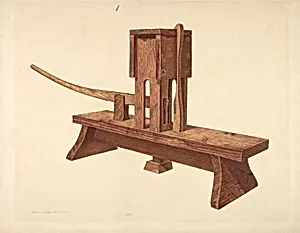
Medium
watercolor and graphite on paperboard
Dimensions
overall: 35.6 x 45.8 cm (14 x 18 1/16 in.) Original IAD Object: overall: 17 1/2" high; bench: 24" long; 6 1/4" high; press: 11 1/4" long; 6 1/2" high; 4 1/8" wide; mold: 3" high; 4 1/2" wide; 1 1/2" long
Classification
Index of American Design
Department
CG-W
Museum
National Gallery of Art, Washington, D.C.
Credit
Index of American Design
Accession Number
1943.8.9019
Rights
Public Domain
Art Historical Context
Behold the charming *Butter Mold* (c. 1940), a delicate watercolor and graphite rendering on paperboard by Edward L Loper. Measuring 35.6 x 45.8 cm, this artwork vividly captures a humble yet ingenious folk craft tool from rural America: a wooden press and mold used to shape butter into decorative paddles or prints. Loper's precise lines and subtle washes highlight the object's functional elegance—its bench-like base, sturdy press (11¼ inches long), and intricate mold (3 inches high)—evoking the tactile world of 19th-century farm life. Created as part of the Index of American Design (IAD), a WPA Federal Art Project from the 1930s-1940s, this piece preserves vanishing American craftsmanship during the Great Depression. Artists like Loper meticulously documented everyday objects, blending technical accuracy with artistic flair to celebrate regional folk traditions. Watercolor's transparency and graphite's fine detail allowed for lifelike texture, from wood grain to ergonomic curves. Today, housed in the National Gallery of Art's collection, *Butter Mold* reminds us of butter's cultural role in early American households—both sustenance and subtle art form. It invites reflection on how simple tools embodied ingenuity, community, and heritage in pre-industrial life.
About the Artist
Edward L. Loper · 1916–2011
Edward Leroy Loper Sr. was born on April 7, 1916, in Wilmington, Delaware, to a poor family in the racially mixed Frogtown neighborhood, where he was raised primarily by his maternal grandmother. After graduating from Howard High School, the only secondary school available to African Americans in Delaware at the time, Loper received no formal artistic training initially but immersed himself in sel...