
Cider Press
c. 1940
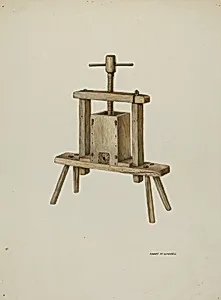
Medium
watercolor, graphite, and pen and ink on paper
Dimensions
overall: 35.9 x 26.6 cm (14 1/8 x 10 1/2 in.) Original IAD Object: 36" wide; 48" high
Classification
Index of American Design
Department
CG-W
Museum
National Gallery of Art, Washington, D.C.
Credit
Index of American Design
Accession Number
1943.8.14733
Rights
Public Domain
Art Historical Context
Harry Mann Waddell's *Cider Press* (c. 1940) is a captivating watercolor, graphite, and pen-and-ink rendering on paper, measuring 35.9 x 26.6 cm. Created as part of the Index of Design (IAD)—a landmark WPA Federal Art Project from the 1930s and early 1940s—this work meticulously documents a traditional American folk object originally standing 36 inches wide and 48 inches high.addell, an IAD artist, employed precise line work and subtle color washes to capture the press's sturdy wooden construction, evoking the ingenuity of rural craftsmanship. The IAD sought to celebrate everyday American design amid the Great Depression, preserving cultural heritage through over 18,000 detailed studies now housed at the National Gallery of Art. Cider presses like this one were essential to colonial and frontier life, squeezing apples into cider—a staple beverage and economic driver in early America. Waddell's technique highlights the object's functional beauty: interlocking beams, levers, and presses rendered with graphite underdrawing for accuracy, then enlivened by ink outlines and watercolor tones that suggest aged wood and patina. This piece invites visitors to appreciate how folk tools embody America's agrarian roots, blending utility with artistic preservation. A testament to New Deal-era creativity, it bridges history and artistry in the CG-W department.
About the Artist
Harry Mann Waddell · 1855–present
Harry Mann Waddell (1876–1956) was an American artist born on June 22, 1876, in Ohio, whose career flourished in California after he settled in Los Angeles by 1936. There he established a studio, working as a freelance draftsman while creating fine art in his spare time. His early life and formal training remain not well documented, but by the late 1930s, Waddell had become a key contributor to th...