
Button
late 18th century
Medium
costume & accessories
Classification
costume & accessories
Department
Smithsonian Collection
Museum
Smithsonian American Art Museum
Credit
Gift of R. Keith Kane from the Estate of Mrs. Robert B. Noyes
Accession Number
1949-94-9
Rights
Public Domain
About this artwork
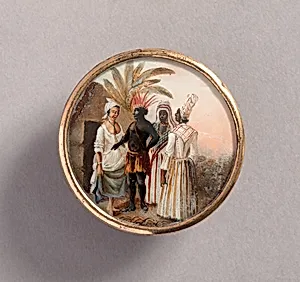
Circular form with painted scene depicting light skinned woman on left in white, low cut bodice with mid-length, ruffled sleeves, loose white overskirt, longer light blue underskirt, barefeet, white scarf on head, and long, tied black ribbon around her neck. She lifts skirts slightly while gazing at black man to her right; he wears short orange and brown skirt, possibly feathered, with brown strap draped diagonally across his bare chest and tall, orange feathered headdress. His left hand is on h...
Art Historical Context
This exquisite late 18th-century by Italian artist Agostino Bruniasca. 1730–1796) captures a vibrant slice of colonial life in a remarkably detailed miniature. Encased under dom glass within a gilded metal, the circular scene depicts light-skinned woman in a white bodice and skirts, shyly lifting her hem as she gazes at a poised Black man in a feathered orange skirt and headdress, who gestures animatedly toward her. In the background, two elegantly dressed Black women in striped, scarves, and turbans observe the pair amid a lush tropical landscape of palms, indigenous architecture, and a sunset-hued sky—showcasing Brunias's masterful use of color and composition on such a tiny scale. Brunias, who worked in the West Indies during the era of British and French colonial expansion, specialized in genre scenes portraying multicultural interactions among Europeans, free people of color, and enslaved individuals. These paintings offer rare glimpses into the social dynamics and fashion of island societies like Dominica, blending European portrait techniques with vivid ethnographic detail. As a functional costume accessory from the Smithsonian American Art Museum's collection, this button highlights the artistry of portable luxury items, transforming everyday adornment into a window on 18th-century cultural fusion and the complexities of colonial life. (198 words)