
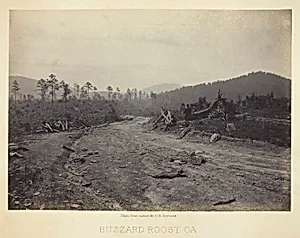
Buzzard Roost, GA
Medium
Albumen print, plate 18 from the album "Photographic Views of the Sherman Campaign" (1866)
Dimensions
Image/paper: 25.5 × 36 cm (10 1/16 × 14 3/16 in.); Album page: 40.9 × 50.9 cm (16 1/8 × 20 1/16 in.)
Classification
albumen silver print
Department
Photography and Media
Museum
Art Institute of Chicago
Accession Number
145436
Rights
Public Domain
Art Historical Context
Step into the scarred landscapes of the American Civil War with *Buzzard Roost, GA* (1866), an evocative albumen silver print by George N. Barnard. Captured as plate 18 Barnard's seminal album *Photographic Views the Sherman Campaign*, this 25.5 × 36 cm image documents a key site in Georgia during Union General William T. Sherman's infamous March to the Sea. Published just a year after the war's end, it offers a stark visual record of the conflict's devastation, blending documentary precision with the era's pioneering photographic techniques. Barnard, a skilled Atlanta-based photographer who served as Sherman's official chronicler, used the albumen process—coating paper with egg white for sharp detail and rich tones—to immortalize military routes, ruins, and strategic points like Buzzard Roost, a rugged tunnel and rail hub. This medium was revolutionary in the 1860s, allowing mass-produced, richly toned prints that brought war's grim reality to Northern audiences, fueling both reflection and propaganda. Housed in the Art Institute of Chicago's Photography and Media Department, this work underscores photography's rise as a tool for history. It invites us to ponder the human cost of victory, where tangled vines and weathered rock whisper tales of endurance amid division.
About the Artist
George N. Barnard · 1819–present
George N. Barnard (1819–1902) was a pioneering American photographer whose six-decade career spanned the dawn of the medium, from daguerreotypes to Civil War documentation. Born into a farming family in Coventry, Connecticut, on December 23, 1819, he lost his father at age seven and apprenticed in family businesses before marrying in 1843 and relocating to Oswego, New York. There, he launched one ...