
Cabinet
plaques 1761–65, cabinet ca. 1822
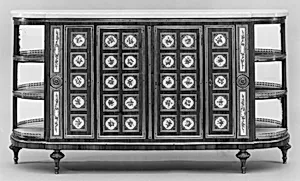
Medium
Oak, tulipwood, gilt bronze, soft-paste porcelain, marble, mirror glass
Dimensions
Overall: 39 1/4 × 73 1/8 × 14 5/8 in. (99.7 × 185.7 × 37.1 cm)
Classification
Woodwork-Furniture
Culture
French, Paris and Sèvres
Department
European Sculpture and Decorative Arts
Museum
Metropolitan Museum of Art, New York, NY
Credit
Gift of Samuel H. Kress Foundation, 1958
Accession Number
58.75.40
Rights
Public Domain
Tags
Art Historical Context
This exquisite cabinet, crafted around 1822 in Paris porcelain plaques from the renowned Sèvres Manuf dated 1761–65, exemplifies opulent fusion of 18th- and early 19th-century French decorative arts. The plaques, painted by artists including Guillaume Noël, Louis-Jeanvenet (père), and Dominique Joffroy, feature delicate floral motifs—a hallmark of Sèvres soft-paste porcelain, for its creamy translucency and fine gilding. These were later mounted by unidentified cabinetmakers onto a structure of oak and tulipwood veneers, adorned with gilt bronze, marble, and mirror glass. The piece reflects the neoclassical revival during France's Restoration period, when collectors repurposed Louis XV-era porcelain treasures into grand furniture. Sèvres porcelain, once favored by royalty, symbolized luxury and technical mastery; its soft-paste body allowed for intricate modeling and vibrant enameling not easily achieved in hard-paste alternatives. Gilt bronze mounts and mirrored panels add sparkle and depth, enhancing the cabinet's role as both functional storage and a showcase for artistry. Measuring nearly six feet tall, this cabinet (gift of the Samuel H. Kress Foundation, 1958) invites visitors to marvel at its layered history—from royal kilns to 19th-century salons—bridging eras in the Metropolitan Museum of Art's European Sculpture and Decorative Arts collection.
About the Artist
Sèvres Manufactory|Guillaume Noël|Louis-Jean Thévenet (père)|Dominique Joffroy|Unidentified · 1740–present
The Sèvres Manufactory, one of Europe's premier porcelain producers, was established in 1740 as the Manufacture de Vincennes under the patronage of Queen Marie Leszczyńska, who sought to rival Meissen and Chantilly porcelains with French soft-paste innovations. Initially a private venture, it relocated to Sèvres in 1756 in a purpose-built facility designed by architect Laurent Lindet near Madame d...