
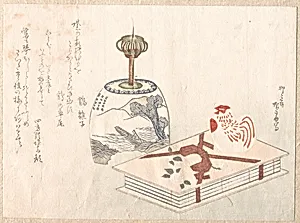
Candlestand and Book
probably 1813
Medium
Woodblock print (surimono); ink and color on paper
Dimensions
5 3/8 x 7 1/4 in. (13.7 x 18.4 cm)
Classification
Prints
Culture & Period
Japan · Edo period (1615–1868)
Department
Asian Art
Museum
Metropolitan Museum of Art, New York, NY
Credit
H. O. Havemeyer Collection, Bequest of Mrs. H. O. Havemeyer, 1929
Accession Number
JP1956
Rights
Public Domain
Tags
Art Historical Context
Ryūryūkyo Shinsai's *Candlestand and Book*, created around 1813 during Japan's Edo period (1615–1868), is a delicate woodblock print known as a *surimono*. These privately commissioned works were luxury items, often produced for poetry circles or New Year's greetings, featuring exquisite printing techniques like subtle embossing, mica dusting, and vibrant colors on paper. Measuring just 5 3/8 x 1/4 inches, this intimate format invited close contemplation of everyday objects—a flickering candlestand beside an open book—elevating the mundane to poetic beauty. Shinsai (1768–1820), a master of the ukiyo-e tradition, specialized in *surimono*, blending realism with elegant minimalism. His still-life compositions, rare in ukiyo-e's focus on courtesans and actors, reflect Zen-inspired appreciation for transience, symbolized here by the candle's fleeting light and scholarly tome. The precise ink and color layering showcases Edo-era craftsmanship, where carvers and printers collaborated to achieve luminous effects. Housed in the Metropolitan Museum of Art's Asian Art Department from the H. O. Havemeyer Collection, this print captures Japan's refined print culture, bridging art, literature, and social ritual for discerning patrons.
About the Artist
Ryūryūkyo Shinsai · 1799–1823
Ryūryūkyo Shinsai (柳々居辰斎), active from 1799 to 1823, was a prominent Japanese ukiyo-e printmaker based in Edo (modern Tokyo), renowned for his mastery of surimono—luxurious, privately commissioned woodblock prints produced for elite poetry circles and New Year's celebrations. He began his training under Tawaraya Sōri before becoming a student of the legendary Katsushika Hokusai, from whom he recei...