
Candle-Stand and Fan
19th century
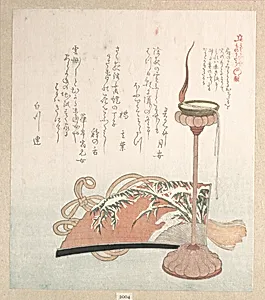
Medium
Woodblock print (surimono); ink and color on paper
Dimensions
8 1/16 x 7 1/4 in. (20.5 x 18.4 cm)
Classification
Prints
Culture & Period
Japan · Edo period (1615–1868)
Department
Asian Art
Museum
Metropolitan Museum of Art, New York, NY
Credit
H. O. Havemeyer Collection, Bequest of Mrs. H. O. Havemeyer, 1929
Accession Number
JP2004
Rights
Public Domain
Tags
Art Historical Context
Kubo Shunman's *Candle-Stand and* is a delicate 19th-century woodblock print from Japan's Edo period (16151868), exemplifying the refined art of *surimono*. These privately commissioned prints, often created for poetry circles or New Year's greetings, were luxurious connoisseur pieces, printed in small editions with exceptional care. Measuring just 8 1/16 x 7 1/4 inches, this intimate work captures everyday objects—a candle-stand and a folded fan—in vibrant ink and color on paper, inviting viewers into the subtle elegance of Japanese domestic life. Shunman (1777–1845), a versatile ukiyo-e artist and kyōka poet, mastered *surimono*'s sophisticated techniques, such as precise color registration, subtle gradations (*bokashi*), and sometimes mica or embossing for texture. Here, the composition highlights the interplay of light and shadow on these motifs, evoking transience (*mono no aware*), a core Edo aesthetic. Fans symbolized status and artistry, while candle-stands hinted at evening rituals, blending utility with poetic beauty. Housed in the Metropolitan Museum of Art's Asian Art collection (H. O. Havemeyer Collection, 1929), this print showcases ukiyo-e's pinnacle of craftsmanship, bridging art and literature in a golden age of Japanese printmaking. A quiet gem for admirers of precision and poetry.
About the Artist
Kubo Shunman · 1757–1820
Japanese, 1757–1820