
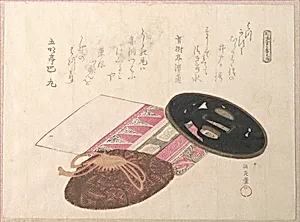
Tsuba (Sword Guard) and Bags
19th century
Medium
Woodblock print (surimono); ink and color on paper
Dimensions
5 1/2 x 7 3/8 in. (14 x 18.7 cm)
Classification
Prints
Culture & Period
Japan · Edo period (1615–1868)
Department
Asian Art
Museum
Metropolitan Museum of Art, New York, NY
Credit
H. O. Havemeyer Collection, Bequest of Mrs. H. O. Havemeyer, 1929
Accession Number
JP1991
Rights
Public Domain
Art Historical Context
This exquisite woodblock print, *Tsuba (Sword) and Bags*, byo Shunman (1777–1845), captures the refined elegance of Edo-period Japan (1615–1868). Created in the 19th century as a *surimono*—a luxurious, privately commissioned print often produced for special occasions like New celebrations—the work showcases a sword guard (*tsuba*) alongside ornate bags. Measuring just 5½ x 7⅜ inches, its intimate scale invites close viewing, revealing Shunman's mastery of ukiyo-e, the "pictures of the floating world" style that celebrated everyday beauty and artistry. Surimono like this one stand out for their superior craftsmanship, employing vibrant inks, delicate colors, and sometimes subtle embossing or mica for a shimmering effect. Shunman, a versatile artist known for his poetic designs and nature motifs, here highlights functional yet artistic objects central to samurai culture. The *tsuba*, typically crafted from iron or bronze with intricate perforations, symbolized status and protection, while the bags evoke the era's appreciation for lacquerware and textiles. Part of the Metropolitan Museum of Art's H. O. Havemeyer Collection (bequeathed in 1929), this print offers a window into Japan's vibrant printmaking tradition during a time of relative peace and cultural flourishing. Visitors will appreciate how it blends utility, symbolism, and aesthetic delight in a single, harmonious composition.
About the Artist
Kubo Shunman · 1757–1820
Japanese, 1757–1820