
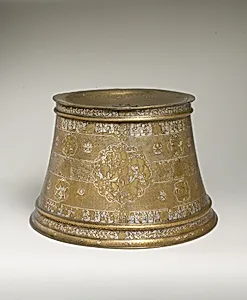
Candlestick with Enthronement Scene
Unknown Artist
second quarter 13th century
Medium
Brass; engraved, incised, inlaid with silver
Dimensions
H. 9 9/16 in. (24.4 cm) Diam. 14 1/2 in. (36.8 cm)
Classification
Metal
Department
Islamic Art
Museum
Metropolitan Museum of Art, New York, NY
Credit
Edward C. Moore Collection, Bequest of Edward C. Moore, 1891
Accession Number
91.1.563
Rights
Public Domain
Art Historical Context
This elegant brass candlestick, crafted in the second quarter of the 13th century, hails from the Islamic world and exemplifies the exquisite metalwork of the medieval period. Standing just under 10 inches tall with a broad 14½-inch diameter base, it served both a practical purpose—holding candles for illumination in mosques, palaces, or—and as a canvas for storytelling. The surface features an enthronement scene, likely depicting a ruler or dignitary seated in majesty, surrounded by attendants, a motif symbolizing authority and courtly life. Artisans employed sophisticated techniques: engraving and incising fine details into the brass, then inlaying them with silver for a shimmering contrast that catches the light. This *damascening* process, common in Islamic metalwork, not only enhanced durability but also created a luxurious, jewel-like effect, making everyday objects into treasures. Such pieces reflect the era's mastery of blending function with opulent decoration, possibly from workshops in Syria or Egypt during the Ayyubid dynasty. Now part of the Metropolitan Museum of Art's Islamic Art collection, gifted through the Edward C. Moore bequest in 1891, this candlestick invites us to imagine flickering candlelight animating its scenes, bridging us to the vibrant cultural and artistic heritage of 13th-century Islam.