
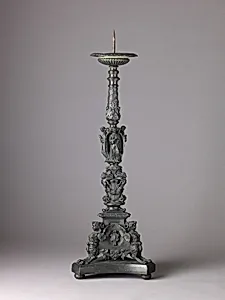
Candlestick with figures of caryatids and putti
19th century
Medium
Copper alloy, with dark green to black patina.
Dimensions
H. 67 cm (excluding pricket).
Classification
Metalwork
Culture
Italian, Venice (?)
Department
Robert Lehman Collection
Museum
Metropolitan Museum of Art, New York, NY
Credit
Robert Lehman Collection, 1975
Accession Number
1975.1.1407
Rights
Public Domain
Tags
Art Historical Context
This elegant 19th-century Italianlestick, standing 67 cm tall (excluding its pricket, or candle spike), exemplifies the artistry of Venetian metalwork—though its precise origin remains tantalizingly marked with a question. Crafted from copper alloy and adorned with a rich dark green to black pat, it features graceful caryatids—female figures inspired by ancient Greek architecture, serving as supportive columns—and playful putti, those cherubic boys common in Renaissance ornamentation. The patina, a natural oxidation over time, enhances its antique allure, giving it the weathered dignity of centuries-old treasures. In the 19th century, Italian artisans often revived classical motifs amid a surge of historicism, blending Renaissance exuberance with neoclassical precision. Here, the caryatids bear the weight with poised strength, while frolicking putti add whimsy, creating a harmonious fusion of solemnity and joy. This piece highlights masterful techniques in casting and chasing metal, where intricate details emerge through skilled hammering and engraving. Housed in the Robert Lehman Collection at The Metropolitan Museum of Art since 1975, this candlestick invites us to ponder Venice's enduring legacy as a hub of opulent craftsmanship, illuminating both literal candles and the cultural splendor of Italy's artistic past.
About the Artist
Italian
The designation "Italian" in art collections typically refers to an anonymous artist or a loose attribution to works from Italian schools, rather than a specific individual. With 173 known artworks in the museum's collection, this entry likely encompasses paintings by unidentified masters active across various periods, such as the Renaissance, Baroque, or later eras. Early life and personal detail...