
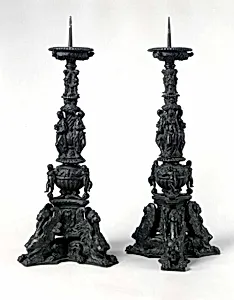
Altar candlestick (pair with 1975.1.1383)
Medium
Copper alloy with a thick black varnish patina.
Dimensions
H. 62 cm.
Classification
Metalwork-Bronze
Department
Robert Lehman Collection
Museum
Metropolitan Museum of Art, New York, NY
Credit
Robert Lehman Collection, 1975
Accession Number
1975.1.1382
Rights
Public Domain
Tags
Art Historical Context
This pair of altar candlesticks, crafted around 1565 by Andrea di Alessand, known as Il Bresciano, the refined metalwork of the Italian Renaissance. Standing at 62 cm tall, these copper alloy pieces—classified as bronze with a distinctive thick black varnish patina— designed for ecclesiastical use, likely flanking an altar in a church setting. Il Bresciano, a sculptor from Brescia, was renowned for his intricate bronze works that blended classical motifs with liturgical function, reflecting the era's revival of antiquity amid Catholic Counter-Reformation fervor. The candlesticks striking decorative elements: graceful caryatids—female figures from ancient Greek architecture serving as supportive columns—and enigmatic sphinxes, symbols of mystery and guardianship. These motifs highlight Mannerist tendencies emerging in mid-16th-century Italy, where artists like Il Bresciano infused religious objects with mythological elegance, showcasing advanced casting techniques and patination for a dramatic, aged sheen. Part of the Robert Lehman Collection at The Metropolitan Museum of Art since 1975, these candlesticks offer a glimpse into Renaissance workshops, where metalwork artistry elevated everyday devotionals into sculptural masterpieces. Visitors will appreciate their tactile allure and the way they bridge pagan symbolism with sacred space.